

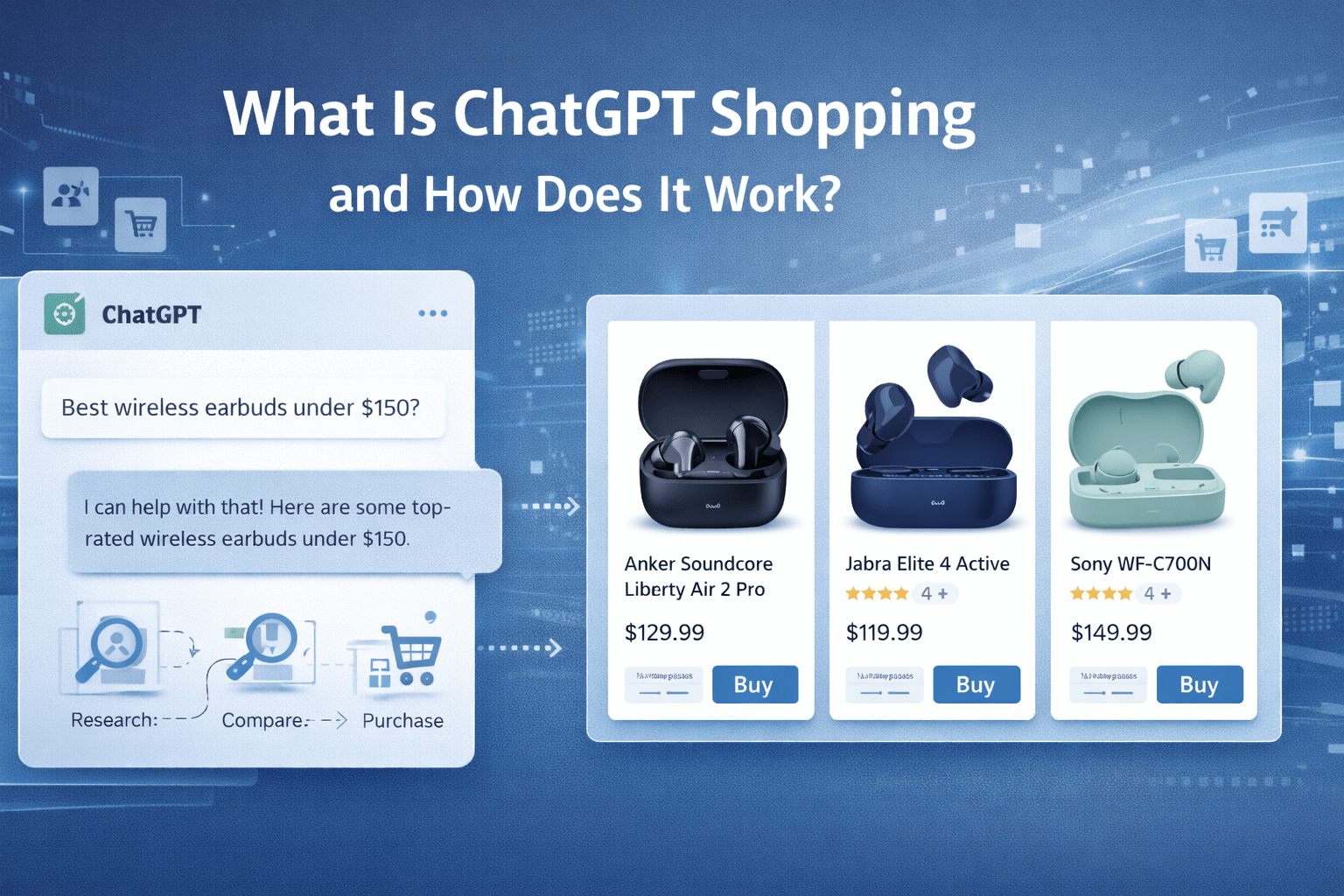

What Is ChatGPT Shopping and How Does It Work?
What Is ChatGPT Shopping and How Does It Work?
Shopping online used to mean translating what you want into keywords, then spending an hour flicking between tabs, reviews, specs, and price trackers. ChatGPT Shopping flips that around. You describe the problem in plain language, and the research comes back organised around your needs, not around a retailer’s category tree.
It feels less like “search” and more like talking to a switched-on assistant who can compare options at speed, ask the right follow-up questions, and summarise the trade-offs without drowning you in jargon.
A plain-English definition
ChatGPT Shopping is a conversational shopping assistant inside ChatGPT. You can ask it to find products, compare shortlisted items, explain differences that matter in real life, and draft a quick buyer’s guide you can act on.
Instead of starting with brands and model numbers, you can start with context: who it’s for, where it’ll be used, what you care about (quiet, durable, easy returns), and what you want to spend.
A key detail is how it presents itself. Product suggestions are intended to be organic rather than paid ads, and it can cite sources so you can check where a claim came from. When checkout is supported, it may even offer a way to complete the purchase without leaving the chat, though availability varies by merchant and region.
What’s actually happening behind the chat
The “magic” is a mix of language modelling and live information retrieval. The model is good at conversation and reasoning, while the retrieval layer pulls in current product data from the web so the answer isn’t limited to what the model learned in training.
That blend matters because shopping is time-sensitive. Prices change. Stock disappears. A “new 2025 model” can replace last year’s favourite overnight. When the system can fetch up-to-date info, your chat can stay grounded in what’s available now, not what was true months ago.
If you’ve enabled Memory, ChatGPT can also carry preferences across chats. That can be genuinely useful (your budget range, your usual sizes, your dislike of noisy appliances), while also raising fair questions about what you want remembered and what you don’t.
From question to buyer’s guide: the typical flow
Most sessions follow a simple rhythm: you ask, it clarifies, it researches, then it summarises.
You might start with something broad like “help me choose a cordless vacuum for a small flat, quiet as possible.” The assistant will usually come back with a few targeted questions, because vague preferences are where bad recommendations are born. A couple of answers from you can save you from buying the “best” product for somebody else’s life.
After it gathers enough constraints, it will generate a shortlist and explain why each item made the cut. The best outputs look like a mini briefing: key specs that matter, review themes, common complaints, and what you’re trading off (price vs battery life, weight vs suction, durability vs features).
One sentence that’s easy to miss: you’re allowed to steer. If you say “more like option 2, but cheaper” or “none of these, prioritise local warranty,” you can reshape the shortlist quickly.
How it differs from normal search (and when that matters)
Classic search is built around pages. ChatGPT Shopping is built around decisions. That changes the shape of the work it does for you.
Here’s a practical comparison.
| Task | Typical search workflow | ChatGPT Shopping workflow | Where the difference shows |
|---|---|---|---|
| Clarifying needs | You do it in your head | It asks questions | Fewer “wrong category” clicks |
| Comparing products | Many tabs, inconsistent specs | Side-by-side summary | Faster trade-offs |
| Reading reviews | Skim lots of long pages | Summarises themes | Quicker sense-checking |
| Checking recency | You check dates manually | It can cite sources | Less stale advice |
| Narrowing options | Filters and more searches | Conversational refinement | Easier when your needs are nuanced |
This approach is strongest when the category has too many near-identical options, when jargon hides the real differences, or when you’re buying outside your comfort zone.
It’s less compelling when you already know the exact model you want, or when the decision depends on tactile factors (fit, feel, noise level in person) that no online summary can fully capture.
What it could mean for Kiwi shoppers
New Zealand shopping has its own constraints: smaller ranges, shipping cost surprises, a mix of local and international warranty conditions, and frequent reliance on a handful of retailers for particular categories. A chat-based assistant can help by starting with “what’s actually available to me” and “what can I return easily” rather than assuming a massive US catalogue.
Adoption won’t be uniform. Surveys reported in local and global commentary suggest younger shoppers are more open to AI-led product advice, while older groups lean towards familiar channels. One set of reported figures put Gen Z comfort with an AI shopping on their behalf around one-third, while broader comfort with AI product recommendations across NZ sits noticeably lower than global averages. That gap reads like a Kiwi trait: practical, curious, and slow to trust anything that feels opaque.
A good shopping assistant earns its place by saving time without asking you to suspend judgement.
After a paragraph of hype, here’s what tends to land well in day-to-day use:
- Quiet appliances
- Gift ideas
- “Best value” upgrades
- Side-by-side comparisons
- Local warranty checks
- High-choice categories: laptops, headphones, robot vacuums
- Constraint-heavy buys: small apartments, shared spaces, allergies, pets
- Replacement urgency: when something breaks and you need a solid pick quickly
- Accessibility needs: weight limits, grip comfort, readability, voice control
Trust, privacy, and the healthy scepticism that keeps you safe
A shopping assistant is only useful if you can rely on it. That doesn’t mean blind trust. It means knowing where mistakes can creep in and building a simple habit of verification.
ChatGPT can be wrong about details like pricing, exact model variants, or whether a feature is included in the NZ SKU. It can also summarise review sentiment accurately while missing a deal-breaking edge case that only shows up in long-term ownership threads.
Privacy is the other pillar. Shopping questions can reveal income, health-related needs, family circumstances, and location patterns. Under the Privacy Act 2020, organisations operating in NZ are expected to be clear about collection and use of personal information, and consumers are right to be cautious with sensitive details.
If you want a simple way to keep control, try these checks as part of your routine:
- Source check: ask it to cite where key claims came from, then open at least one link
- Recency check: ask “how recent are these prices and reviews?”
- Local check: ask “is this the NZ model, with NZ warranty, NZ plug, NZ voltage?”
- Deal-breaker check: ask “what would make someone regret buying this?”
That last one is powerful. It forces the assistant to surface downsides, not just sell you a story.
Instant checkout and the changing shape of convenience
Where supported, in-chat checkout turns the assistant from “research tool” into “purchase pathway”. For shoppers, that can mean fewer steps, fewer abandoned carts, and a shorter time between decision and delivery.
It also shifts who owns the customer relationship at the moment of purchase. If checkout happens inside a platform layer, the retailer may see less behavioural data and fewer chances to cross-sell on-site, while the shopper gets speed and a single interface.
Convenience is never free. It’s paid for with reliance on the platform’s accuracy, its security posture, and its dispute handling when something goes wrong. That’s why many Kiwis will still prefer clicking through to the retailer to confirm stock, shipping timelines, and returns in black and white.
What retailers and brands should notice (even if you’re not “into AI”)
If shoppers begin starting their product research in chat, being findable becomes less about winning a search results page and more about being legible to systems that summarise the web.
That changes priorities. Clear product data, precise specs, honest FAQs, and well-structured policies become growth assets, not just admin.
After a paragraph of theory, here are the practical signals that tend to help:
- Clean product metadata: consistent naming, variants, dimensions, weights
- Visible policies: warranty, returns, delivery timeframes written clearly
- Real review content: detailed customer feedback that covers common scenarios
- Local context: NZ plug and voltage info, NZ compliance notes, local support details
None of that is flashy. It is persuasive, and it tends to be the difference between “shortlisted” and “skipped”.
Getting better results: prompts that act like a brief
The quality of the output is strongly tied to the quality of the brief you give it. You do not need special syntax, just the right constraints.
A strong prompt usually contains: use-case, constraints, budget range, preferences, and what you already tried. If you have a shortlist, paste it in and ask for a structured comparison.
A simple template that works well:
“Help me choose . I’m in NZ. Budget is $X to $Y. Must have: [A, B]. Must avoid: [C]. It’s for: [use-case]. Prioritise: [quiet/durable/lightweight/repairable]. Include: warranty and returns considerations, and cite sources for key claims.”
One sentence can save you money: ask it to rank options twice, once for “best overall” and once for “best value for money”, then explain the difference in plain terms.
Where this is heading
ChatGPT Shopping points to a near future where product research becomes more conversational, more personalised, and less tied to whoever has the best SEO budget. That’s an optimistic shift for consumers, especially in categories where choice overload is real and time is tight.
It will also keep raising smart questions for New Zealand shoppers: how much you want remembered, how recommendations stay unbiased, and what level of verification feels right before you click “buy”.