


Exploring Google Gemini Ads: A New Era in Digital Marketing
Exploring Google Gemini Ads: A New Era in Digital Marketing
Google search advertising is moving into a more conversational, AI-assisted phase, and that shift is no longer theoretical. Google has started tying Gemini into new Search ad experiences while also giving advertisers AI Max controls inside Search campaigns. That combination matters because it changes both the format people may see and the way campaigns are built behind the scenes.
For marketers in New Zealand and beyond, this is a meaningful change in practice, not just in branding. The old model centred heavily on keyword lists, static ad copy, and manual expansion. The newer model still values strategy and intent, yet it asks advertisers to feed stronger inputs into Google’s systems and manage campaigns with a sharper eye on signals, creative quality, and reporting.
Why Google Gemini Ads matter for Search advertising
Google’s recent direction suggests a broader role for Gemini in Search ads. In a Google blog post published on 20 May 2026, the company said it was testing new ad formats built with Gemini in Search. That is a clear sign that AI is not sitting off to the side as a copy assistant. It is becoming part of how ad experiences are presented inside Google’s core search environment.
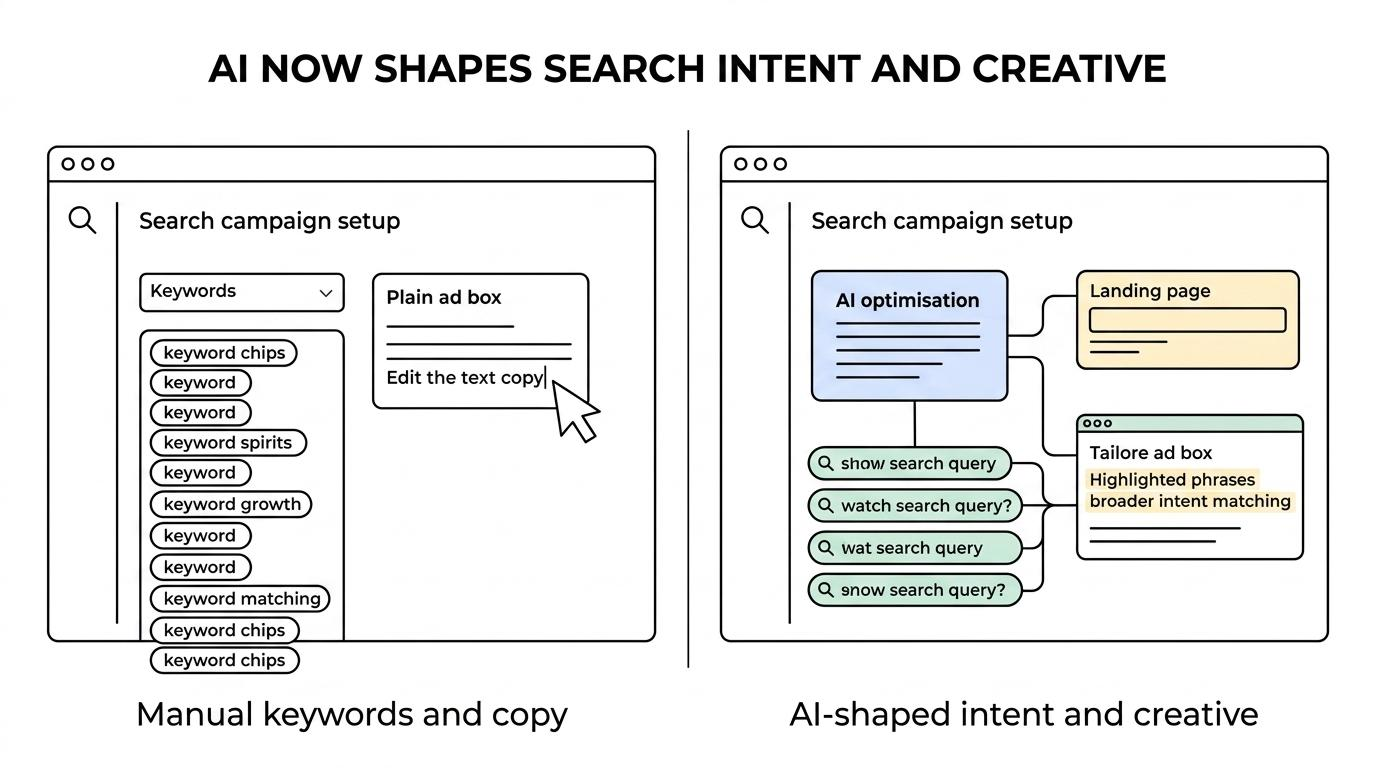
Side-by-side comparison of traditional Google Search advertising and newer Gemini and AI Max-driven search campaigns.
The named formats are especially telling. They point to a search experience that can respond to nuance, context, and richer commercial intent, rather than only matching a tightly defined keyword phrase to a standard text ad.
- Conversational Discovery ads
- Highlighted Answers
- AI-powered Shopping ads
- Direct Offers expansion with native checkout and travel deals
This matters because search behaviour has been shifting for years. People ask longer questions, compare options in a single session, and expect useful summaries before they click. Gemini-linked ad formats fit that pattern. If these formats expand, advertisers will need to think less like auction technicians and more like publishers with strong offers, clear proof, and useful landing pages.
There is also a competitive angle. Early movers often gain the benefit of cheaper learning, faster feedback, and a better feel for what AI systems reward. That does not mean every advertiser should rush in without guardrails. It does mean waiting too long could leave a brand learning the new rules after competitors have already shaped demand.
How AI Max works in Google Search campaigns
Alongside new Gemini-linked formats, Google Ads has been adding AI Max for Search campaigns. According to Google Ads Help, AI Max uses two core features: search term matching and asset optimisation. Together, they let Google optimise ads in real time and tailor creative messaging more dynamically than a traditional setup.
Search term matching expands how a campaign can capture relevant queries. When AI Max is switched on, Google says search term matching is enabled at the campaign level, though advertisers can turn it off at the ad group level. That matters because it gives a campaign wider reach while still preserving some tactical control where precision is needed.
Asset optimisation changes the creative side. Google says advertisers can generate customised assets from domain content, landing pages, existing ads, keywords, and other assets by enabling text customization. In practice, that means the quality of your website, offer pages, and current messaging becomes even more important. Weak source material will not become strong just because AI is involved.
A quote highlight featuring the line about weak source material staying weak even with AI.
Unlike Performance Max, which spans multiple channels, AI Max sits inside Search campaigns. That makes it attractive for advertisers who want AI support within a more familiar search structure, with clearer campaign intent and tighter relation to search demand.
| AI Max capability | What Google says | Practical meaning for advertisers |
|---|---|---|
| Search term matching | Expands matching within the campaign | More reach across relevant queries, with care needed around traffic quality |
| Asset optimisation | Tailors creative messaging in real time | Landing page and ad input quality becomes a major performance driver |
| Text customization | Can generate customised assets from site content, keywords, and ads | Brands need stronger source copy and cleaner offers |
| Ad group control | Search term matching can be toggled off at ad group level | Helpful where tighter control is needed for brand, compliance, or margin reasons |
| Reporting views | Views include search terms, headlines, URLs, landing pages, and assets | Better visibility than a pure black-box automation model |
What changes in campaign inputs for Google Gemini Ads
The rise of Gemini-linked ads and AI Max means campaign setup is becoming less about building ever-larger keyword lists and more about supplying better strategic material. Google’s systems can only optimise against what they can read, test, and connect to intent.
That shifts pressure upstream. Product feeds, service pages, offer clarity, conversion tracking, location signals, and audience cues all matter more when AI is constructing or adapting messages at speed.
A strong setup usually includes:
- Landing pages: clear offer, fast load times, visible proof, relevant calls to action
- Site content: category pages, service details, FAQs, pricing cues, brand language
- Existing assets: strong headlines, descriptions, images, and extensions
- Clean conversion tracking
- Search intent mapping
- Commercial clarity
There is a creative discipline hidden inside this. Brands that speak vaguely about value often struggle when automation increases, because the system has too little to work with. Brands with crisp commercial language, useful page structure, and tightly matched offers tend to give the AI better material.
This is one of the reasons many teams are revisiting old search accounts. The issue is not always media spend. Sometimes the campaign is held back by thin pages, weak copy, messy tracking, or an account structure built for an earlier version of Google Ads.
Reporting and control for Google Gemini Ads
One concern often raised around AI in advertising is loss of visibility. Google appears to be answering that concern, at least in part, with more reporting views inside AI Max. Google Ads Help says advertisers can see reporting for search terms, headlines, URLs, landing pages, and assets to understand campaign contribution and performance.
That is useful because it gives marketers a way to judge whether the system is matching into the right queries and sending traffic to the right destinations.
When reviewing AI Max performance, these are sensible checks:
- Search terms: are newly matched queries commercially relevant?
- Headlines: do generated or selected messages reflect the brand accurately?
- Landing pages: is traffic reaching the best page for the user’s intent?
- Assets: which combinations are driving conversions rather than just clicks?
Good reporting does not remove the need for human judgement. It makes that judgement more grounded. Teams can spot drift, protect brand language, and refine source inputs instead of blindly accepting whatever the machine produces.
Choosing a Google Ads partner for Gemini-era campaigns
As Google adds more AI into Search advertising, the role of specialist support becomes more practical. The question is no longer only whether an agency can manage bids or write copy. The stronger question is whether it can shape inputs, interpret reporting, and apply control without slowing the speed that AI makes possible.
Public proof points matter here. One provider in this space, Webzilla, presents a set of quantified signals on its public pages. It states that it is a Top 3% Google Verified Digital Marketing Agency in the Oceania region. It also lists 586 projects, 82 marketing campaigns, 178 design recognitions, and 736 creative and original prints. On its Google Ads service page, it also says it is in the top 3% of 1000+ partners in the Oceania region holding the Google Premier Partner title, and describes its work as including real-time bid adjustments, keyword refinement, and ad copy changes.
Those figures are useful because they are specific enough to assess, even if any buyer should still verify current status, scope, and relevance directly. In a Gemini-influenced ad environment, that kind of evidence is more helpful than generic claims about being data-driven or results-focused.
A capable partner should be able to do three things at once: keep strategy clear, work confidently with Google’s newer controls, and maintain disciplined reporting. AI speeds execution. It does not replace accountability.
A practical rollout plan for Google Gemini Ads
Most advertisers do not need a dramatic rebuild on day one. A staged rollout is often the safer move, especially when brand controls, margins, or lead quality are sensitive.
Start with one search campaign where intent is already strong and measurement is reliable. That gives you a cleaner test bed and a clearer read on what AI Max and Gemini-linked formats may be adding.
A sensible approach might look like this:
- Audit first: check conversion tracking, landing page relevance, and asset quality before enabling new automation.
- Turn on AI Max selectively: use an existing Search campaign or build a new one in a contained segment.
- Review reporting weekly: watch search terms, headlines, URLs, landing pages, and asset combinations for signs of drift or missed opportunity.
- Scale with evidence: move into more categories after performance, lead quality, and brand fit are proven.
This kind of rollout helps teams learn the system rather than react to it. It also creates a cleaner record of what changed and why, which is useful when reporting back to leadership or clients.
Google’s direction is clear enough now to act on. Gemini-linked ad formats are starting to shape the Search experience, and AI Max is giving advertisers a way to bring more of that intelligence into Search campaign management. The opportunity is real for brands willing to tighten their inputs, watch reporting closely, and treat AI as a high-speed partner rather than a replacement for strategy.
References
- Google Blog: Introducing new AI-powered ad formats in Search (20 May 2026)
- Google Ads Help: About AI Max for Search campaigns
- Webzilla: What is Google Ads and How it Works?
- Google Ads Help: Search term matching and asset optimisation
- Google Premier Partner Program
- Search Engine Journal: How AI is Changing Google Ads
- Think with Google: The future of search advertising