


What is Domain Authority? A Comprehensive Guide for 2026
What is Domain Authority? A Comprehensive Guide for 2026
Ask three marketers what “domain authority” means and you’ll often hear three different answers. One will quote a number from Moz. Another will equate it with backlinks. A third will say Google doesn’t use it at all, so you can ignore it. Each has a kernel of truth. The practical reality sits somewhere in between.
You do not need to worship a score to benefit from the idea. Treat domain authority as a shorthand for a site’s overall link-driven reputation. When that reputation is strong, new pages tend to index quickly, attract more keywords, and stand a better chance against tough competitors. When it is weak, even decent pages can feel invisible.
What is Domain Authority
Long before the metric capitalised as Domain Authority existed, researchers were building models of “hubs and authorities” in link graphs. Early PageRank observations in Google’s formative years reinforced a pattern many SEOs noticed: older domains with many credible links could rank far more easily than thin or new sites. Over time, the industry adopted a loose idea of site authority.
Moz later gave this idea a name and a scale. That helped people compare sites and communicate with stakeholders. It also created confusion, since one vendor score became a catch‑all phrase. Still, the core concept has persisted because it mirrors how the open web works: reputable sites accrue references, and those references pass value.
How is Domain Authority Calculated?
Domain Authority is calculated using a proprietary algorithm developed by Moz, which takes into account a wide range of factors such as the quality and quantity of inbound links, linking root domains, and other signals. Because this algorithm is regularly updated to reflect changes in search engine behaviour and advancements in SEO, your Domain Authority score can fluctuate even if you haven’t made significant changes to your website. These updates ensure the metric remains accurate and relevant, but they also mean it’s important to monitor your score over time and not be alarmed by occasional shifts.
Moz’s score and Google’s view
Moz’s Domain Authority (DA) is a 1 to 100 score that predicts how well a domain might rank compared with others. Higher means stronger, and the scale is logarithmic, so it gets harder to climb at the top. Importantly, DA is a prediction based on observed search results and link data, not a ranking factor inside Google.
Google has been clear for years that it does not use Moz DA, Ahrefs DR, Majestic TF, or any third‑party authority score. The search engine evaluates hundreds of signals and has its own link calculations. That does not make DA irrelevant; it makes it a proxy. When DA rises due to real, high‑quality links, the same link improvements are signals Google can use.
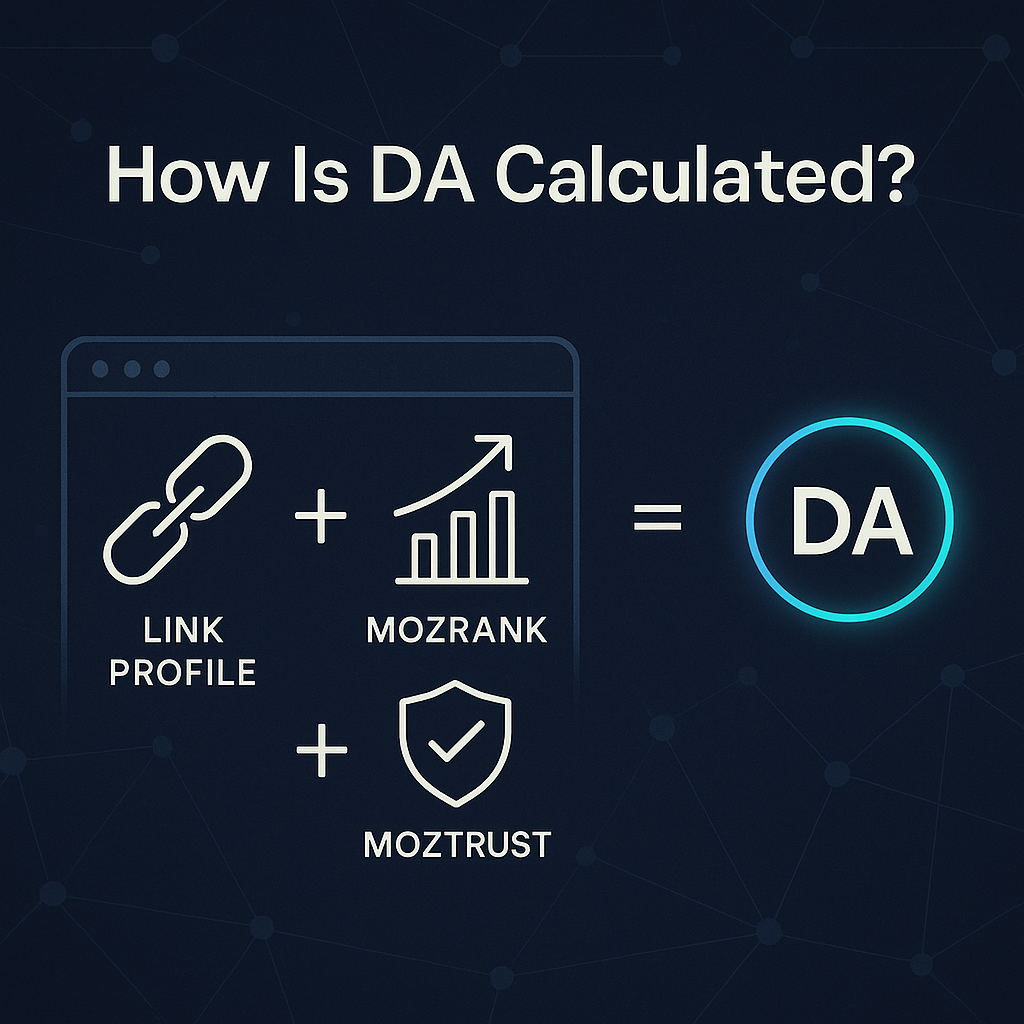
How DA is modelled today
Old versions of DA placed weight on things like MozRank and MozTrust. Since 2019, Moz has shifted to a machine‑learning model trained against large search results sets. Inputs include linking root domains, total links, the quality and distribution of those links, and spam indicators. The exact recipe is proprietary.
Two points matter for decision making. First, DA is relative. Your number only means something when compared with a competitor set. Second, DA is link‑centric. Content quality and UX matter because they help you earn links and engagement, but DA itself is mostly a reflection of backlink strength and cleanliness.
Moz also scores at the page level. Page Authority (PA) runs on a similar idea, focused on an individual URL’s link profile. It can be handy when analysing whether to update an existing page or create a new one.
Related scores you will see in tools
Other vendors built their own versions to suit their datasets and philosophies. They differ in inputs and outputs, yet they all attempt to summarise link prominence and site quality. The names vary, the common thread is comparison.
Here is a quick side‑by‑side to keep the terminology straight:
| Metric | Scale | What it emphasises |
|---|---|---|
| Domain Authority (Moz) | 1–100 | Predictive, relative site strength based on link quantity, link quality, and spam signals |
| Domain Rating (Ahrefs) | 0–100 | Strength of a domain’s backlink profile and how link equity flows through the graph |
| Trust Flow (Majestic) | 0–100 | Quality of links seeded from a vetted set of trusted sites |
| Citation Flow (Majestic) | 0–100 | Quantity of links regardless of trust, best interpreted alongside TF |
| Authority Score (SEMrush) | 0–100 | Compound indicator blending backlinks, estimated organic traffic, and spam factors |
No one of these is a master key. Each shines a light from a slightly different angle. For competitive work, the best move is to choose one or two you trust, then stick to them for consistent comparisons.
Domain Authority vs Authority Score: Key Differences Explained
Authority Score (AS) and Domain Authority (DA) are both metrics designed to estimate the overall strength and credibility of a website, but they differ in their methodology and focus. Domain Authority, developed by Moz, is a predictive score ranging from 1 to 100 that primarily evaluates the quality and quantity of a site’s backlinks, as well as spam indicators. Its main purpose is to estimate how likely a domain is to rank in search results compared to others, with a strong emphasis on link-driven reputation.
In contrast, Authority Score, created by SEMrush, is also measured on a to 100 scale but takes a more holistic approach. AS blends multiple factors, including backlink data, estimated organic search traffic, and spam signals, to provide a compound indicator of a domain’s overall authority. This means that while backlinks remain important, AS also considers how much organic visibility a site achieves and the trustworthiness of its traffic sources.
The key difference lies in their scope: DA is almost exclusively link-centric and best used for comparing relative link strength between domains, whereas AS incorporates a broader set of signals, offering a more comprehensive view of a site’s performance and reputation in search. For marketers, DA is ideal for assessing link-building progress, while AS can be more useful for evaluating the overall health and competitiveness of a website.
Domain Authority vs. Domain Rating: What’s the Difference
When evaluating the strength of a website, two popular metrics often come up: Domain Authority (DA) and Domain Rating (DR). While both are widely used in the SEO industry, they are developed by different companies and have distinct calculation methods.
Domain Authority (DA) is a metric created by Moz. It predicts how likely a website is to rank on search engine results pages (SERPs) based on a variety of factors, including the quality and quantity of inbound links. DA scores range from 1 to 100, with higher scores indicating a greater ability to rank.
Domain Rating (DR), on the other hand, is developed by Ahrefs. DR also measures the strength of a website’s backlink profile on a scale from 1 to 100, but its calculation is based solely on the quality and quantity of external backlinks pointing to the domain.
Key Differences
- Source: DA is from Moz; DR is from Ahrefs.
- Calculation: DA uses a complex algorithm that considers multiple factors, including linking root domains and Moz’s proprietary data. DR focuses primarily on the strength and number of unique backlinks.
- Update Frequency: Both metrics are updated regularly, but the frequency and data sources differ.
- Purpose: Both are used to gauge a website’s authority, but DR is often preferred for backlink analysis, while DA is more commonly referenced in general SEO discussions.
When to Use Each Metric
- Use Domain Authority (DA): When you want a broad estimate of a website’s overall ability to rank in search engines, or when comparing sites using Moz’s suite of SEO tools.
- Use Domain Rating (DR): When conducting in-depth backlink analysis, especially if you’re using Ahrefs to evaluate link-building opportunities or competitor link profiles.
Both metrics provide valuable insights, but it’s important to use them consistently and understand their unique methodologies. For the most accurate picture of your website’s authority, consider monitoring both DA and DR over time.
Why marketers still care
Across countless SERPs, you will notice a pattern. Big, well‑linked domains often occupy prime real estate for competitive head terms. This happens even when a challenger produces a page of similar quality. Strong sites have a structural advantage. They are crawled more often, their internal links carry more weight, and their new pages earn references faster.
Authority also shapes human behaviour. Searchers recognise brands and click them. Editors are more likely to cite sources they already know. Sales partners prefer working with credible sites. Over time, these human signals produce more links, and the flywheel turns a little faster.
DA by itself is not a crystal ball. Statistical studies find weak direct correlations with exact positions. That is expected, given it compresses a complex web into one number. Yet for planning and forecasting, DA remains useful. If competitors in the top ten cluster around DA 80 to 90 and you sit at 18, the gap tells you to adjust expectations, budget, and timelines. If you are already within touching distance, content quality and topical depth might be the deciding factor.
Smart ways to build authority that lasts
Authority compounds from real usefulness and reputation. That calls for work across on‑page, off‑page, and technical fronts, with a long‑term mindset. Start with a quick prioritisation, then commit.
Before we list tactics, a guiding principle: build the thing people want to cite, then make it easy for them to find, understand, and trust.
- Editorial calibre content: Produce original research, practical frameworks, or tools people rely on. Think of “link‑worthy” as a standard, not a fluke.
- Information architecture: Create clear topic hubs that concentrate internal links and signal expertise across clusters.
- Technical hygiene: Fast pages, clean code, mobile performance, secure HTTPS. Friction costs links and patience.
- Digital PR: Pitch compelling angles to journalists and industry newsletters. One strong editorial link can outweigh dozens of weak ones.
- Partnerships: Co‑create webinars, reports, or case studies with respected organisations. These often earn multiple references.
- Community presence: Answer questions in niche forums and professional groups. Helpful contributions attract natural mentions over time.
After mapping your foundation, turn to execution that respects quality and risk.
- Content freshness: Update cornerstone guides and data annually. Stale resources stop earning links.
- Internal linking: Systematically connect related pages. Pass equity to pages that should rank for your commercial terms.
- Link acquisition tactics: Target relevant, reputable sites rather than raw volume. Guest articles, resource pages, broken link replacement, and expert quotes can all work when done with care.
- Local signals for NZ brands: Build complete profiles across regional directories, Chambers of Commerce, and trusted .govt.nz or .ac.nz partnerships where appropriate. Quality local citations reinforce credibility.
Common traps that drain momentum
Plenty of teams waste effort chasing the score or cutting corners. You can avoid that with a few firm lines in the sand.
- Buying links at scale
- Ignoring slow load times
- Keyword‑stuffed anchors
- Neglecting internal links
- Thin, me‑too content
- One‑off campaigns with no follow‑through
Each of these either creates risk or starves your site of the ingredients that earn genuine attention. The safest route is still the most durable one.
New domains vs established sites
A brand‑new domain usually sits near zero. Early wins come from building topical depth and securing a handful of high‑quality references. That might mean publishing a definitive starter guide for your niche, earning coverage in a relevant trade publication, and getting listed with credible industry bodies. Momentum matters in the first six months, so aim for consistency over splashy one‑offs.
An established site has different levers. A thorough content audit can prune or merge weak pages, lifting average quality and concentrating authority. Your brand recognition opens doors for data studies, co‑marketing, and high‑tier placements. You can also retrofit internal links at scale to surface underperforming assets. Think of this as compound interest on work already done.
In both cases, set guardrails. Avoid shortcuts that promise big DA jumps without substance. Make sure every tactic would still make sense if DA did not exist.
How to measure progress and plan your next move
Pick your metrics and stick to them. Track DA or DR as a convenience, but judge success on the things that move a business forward: rankings for target topics, organic sessions, conversions, and the calibre of referring domains.
Add context before setting targets. Compare your numbers against the sites ranking for the keywords you care about. Look at ranges, not single points. Factor in the quality of their content, their publishing velocity, and how deep their link profiles run in your topic area.
A simple cadence works well:
- Baseline: Export current DA/DR, referring domains, top pages by links, and keyword rankings.
- Quarterly focus: Set a small number of initiatives that can measurably improve link‑earning potential. Example: one data study, one partner report, one technical speed sprint.
- Monthly review: New referring domains, link quality mix, pages gaining links, and any toxic patterns to disavow.
- Competitive gap: Recheck the top ten for your priority topics and adjust content angles or outreach lists accordingly.
For Kiwi organisations, layer on regional nuance. Links from respected .co.nz publishers, universities, and government programmes often carry outsized trust within local SERPs. Community sponsorships that result in editorial coverage can be both good citizenship and good SEO.
A practical note on expectations
Authority growth behaves like a curve, not a straight line. Going from DA 10 to 20 can be faster than 50 to 60, and far faster than 70 to 80. That is by design with logarithmic scales, and it mirrors how reputation works in the real world.
Plan for steady, compounding gains. Make a calendar that mixes durable assets with timely commentary. Engineer your site so every new page is easy to crawl, enjoyable to use, and tightly connected to a relevant hub. When your content earns attention, capture it with smart internal links and strong calls to action.
Do this well and the score tends to take care of itself. The rankings will tell the same story.