


Why Traffic Growth Doesn’t Always Mean Business Growth
Why Traffic Growth Doesn’t Always Mean Business Growth
Traffic charts can be exciting. A rising line suggests momentum, market interest, and stronger visibility. For many businesses, more website traffic feels like proof that marketing is working.
Yet traffic on its own is not the same as commercial progress.
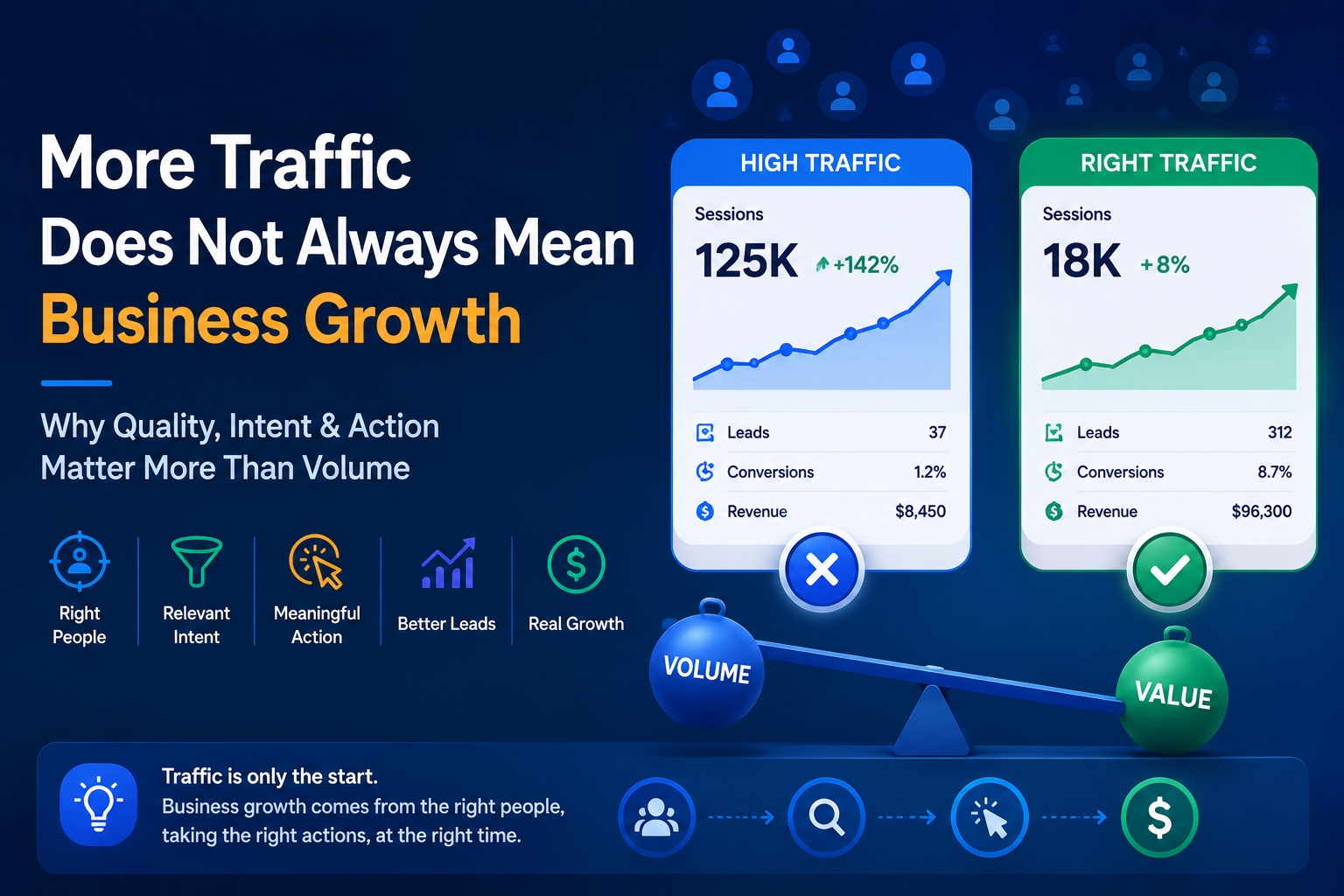
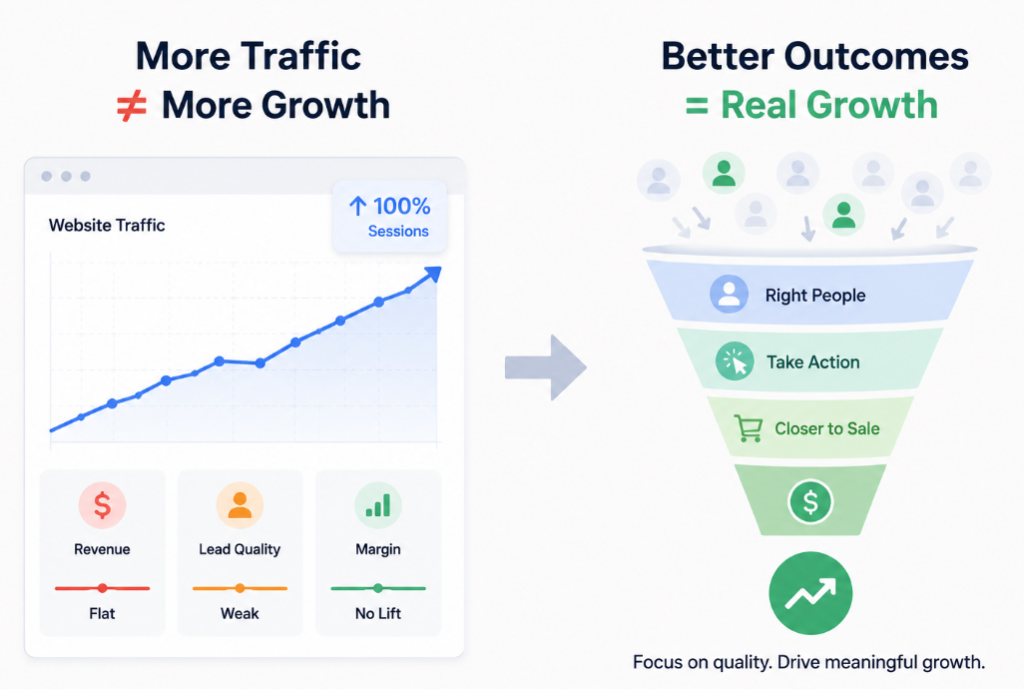
A business can double its sessions and still see flat revenue, weak lead quality, and no real lift in margin. That gap matters. It changes how marketing should be judged, how budgets should be set, and how growth should be planned.
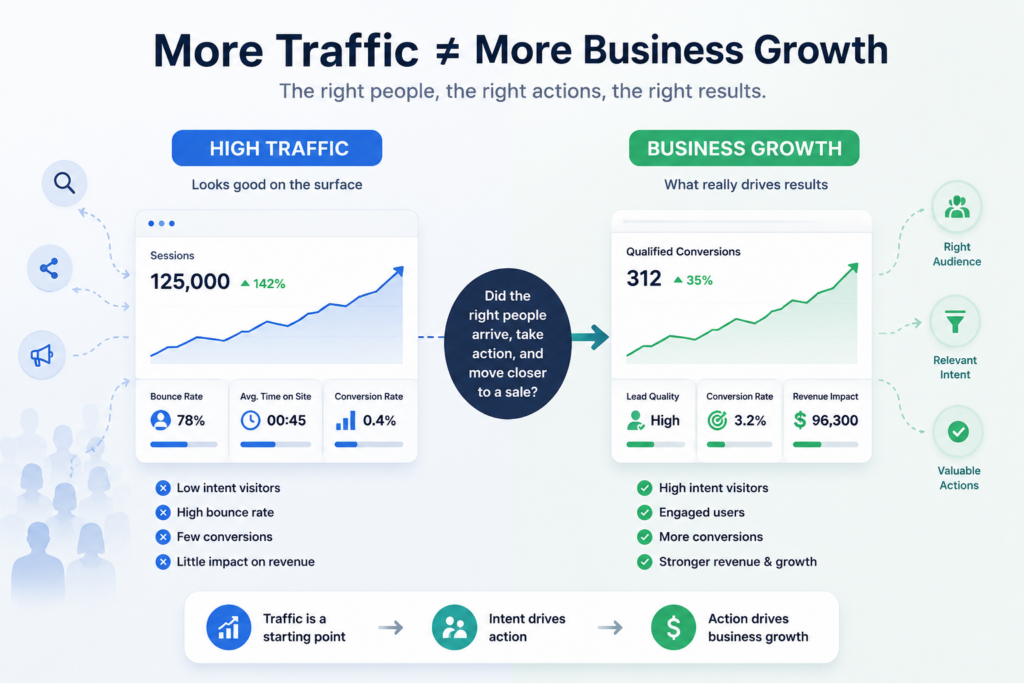
For brands investing in SEO, SEM, social media, and web development, the real question is not “How many people visited?” It is “Did the right people arrive, take action, and move closer to a sale?”
Why website traffic is often treated as the main growth signal
Website traffic is easy to find, simple to compare, and visually impressive in reports. Platforms surface it quickly, which makes it one of the first numbers people see in analytics dashboards. Teams also like it because it suggests reach, visibility, and audience interest without much explanation.
There is value in that. More traffic can mean stronger brand awareness, broader keyword coverage, or more effective media buying. In early-stage campaigns, it can also be a useful signal that visibility is improving.
The problem starts when traffic becomes the headline metric and everything else becomes secondary.
A business does not grow because more browsers loaded a page. It grows when demand is matched with intent, experience, trust, and conversion.
Website traffic quality matters more than website traffic volume
Not all visits carry the same commercial value. One hundred visits from people actively comparing suppliers can be worth far more than ten thousand visits from users looking for something loosely related to your offer.
That is why raw traffic totals often hide the truth. A campaign may pull in large numbers from broad informational keywords, low-intent social clicks, or poorly matched display placements. The graph looks healthy. The pipeline does not.
A better way to assess traffic is to focus on quality signals rather than volume alone. High-intent visitors, returning users, product or service page engagement, enquiry-start sessions, and traffic from target locations often reveal far more about commercial potential than raw session numbers.
When traffic is increasing, businesses should look beyond the headline numbers and ask deeper questions. Are the visitors decision-makers or casual researchers? Are they looking for pricing, comparisons, or quick answers? Are they landing on high-conversion service pages or low-intent blog content? Most importantly, are they taking meaningful action or leaving within seconds?
If those answers are weak, traffic growth may be little more than audience inflation.
Search intent mismatch can quietly limit business growth
Search visibility can improve while business performance stays stuck because the traffic being captured does not match buying intent.
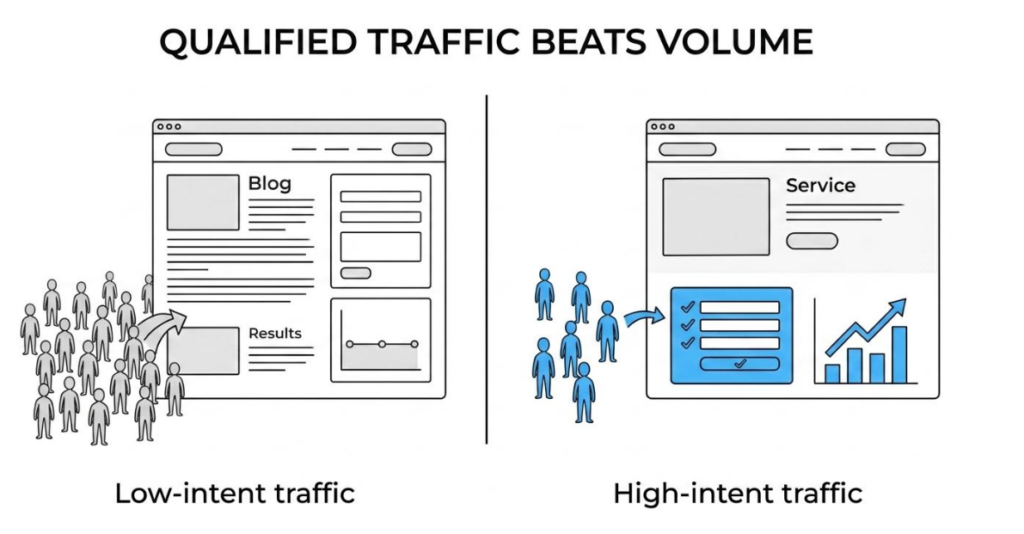
A site might rank well for educational topics that attract broad interest but little commercial action. A home improvement company may gain thousands of visits from “how to fix a leaking tap” while generating very few quote requests. A B2B software brand may pull in readers for “what is workflow automation” yet struggle to turn them into qualified demos.
This does not mean informational content is a bad investment. It can support authority, trust, remarketing audiences, and future demand. Still, it needs to sit within a wider system that also targets users closer to decision.
Different traffic sources often carry very different levels of commercial value. Informational blog traffic usually attracts users in the early research stage and may contribute more to awareness than direct conversions. Commercial search traffic tends to attract users comparing providers or evaluating solutions, making it far more valuable for lead generation. Branded traffic is often highly valuable because users already know the business and are actively seeking it out. Paid social traffic can vary significantly depending on audience targeting and landing page alignment, while returning visitors frequently indicate ongoing consideration and stronger buying intent.
A healthy strategy usually includes a mix. The issue is not having top-of-funnel traffic. The issue is mistaking it for direct business growth.
Why Ranking First Does Not Always Create Business Growth
A high ranking can improve visibility, but visibility alone does not guarantee commercial growth. Many businesses assume that reaching the top of Google automatically leads to stronger revenue, more qualified leads, and better long-term performance. In reality, the relationship between rankings and business outcomes is often far more complicated.
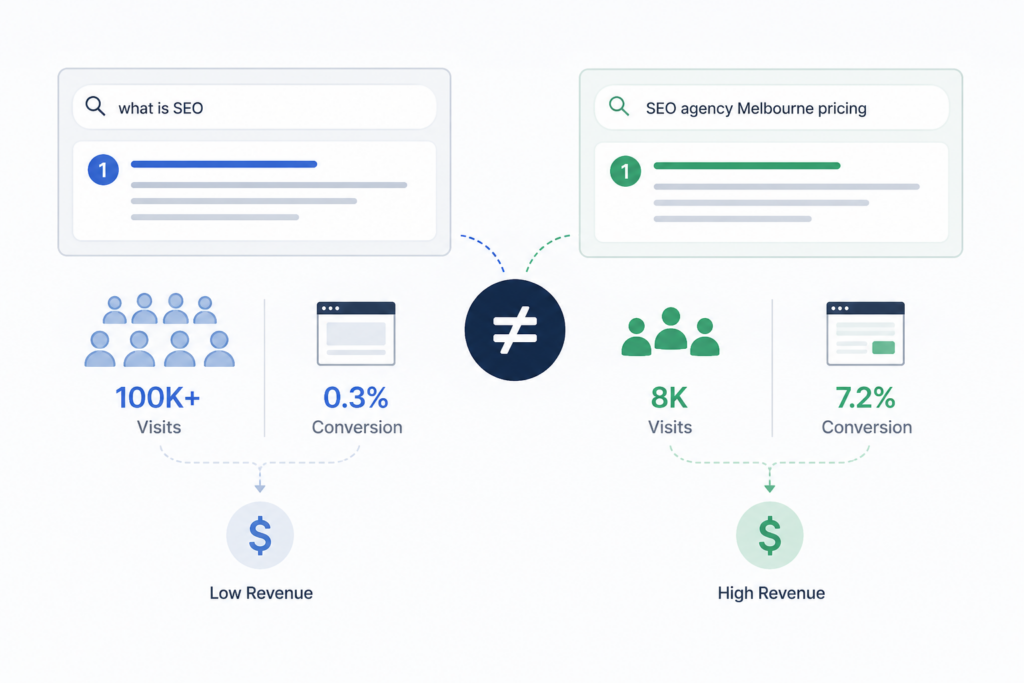
Some keywords generate large search volumes while carrying very weak buying intent. Others attract fewer searches but produce significantly stronger enquiries, sales conversations, and conversions. A page ranking first for a broad informational query may drive substantial traffic while contributing very little to pipeline or revenue.
For example, a business ranking highly for a search like “what is SEO” may attract students, researchers, and casual readers from a wide range of locations and industries. In contrast, a search such as “SEO agency Melbourne pricing” or “best ecommerce SEO agency Australia” may bring far less traffic but far more commercially relevant visitors.
This distinction matters because rankings are often reported without enough context. A campaign can appear successful based on keyword positions while the sales team sees little improvement in lead quality or conversion volume. In some cases, businesses even expand traffic into audiences that are unlikely to buy, creating additional reporting noise without improving commercial performance.
Search intent plays a major role here. Informational visibility can support brand awareness, authority, and future demand, but commercial growth usually comes from attracting users closer to decision-making. Businesses that focus only on rankings often overlook whether the traffic being won actually aligns with revenue goals.
There is also growing evidence that search behaviour itself is changing. With AI-generated summaries and answer engines surfacing quick information directly in search results, users increasingly click only when they are ready to evaluate options more seriously. That means lower-volume, high-intent queries may become even more commercially valuable over time.
High rankings are still useful. High-intent rankings are profitable. The strongest SEO and GEO strategies are not designed simply to maximise visibility. They are designed to attract the right audience at the right stage of intent and move them towards meaningful business outcomes.
Conversion friction can waste strong website traffic
Sometimes the traffic is right, but the website is not doing its job.
A business may attract ideal visitors through search or paid media, then lose them because the next step feels unclear, slow, or risky. Weak forms, vague messaging, cluttered layouts, missing trust signals, and poor mobile performance all reduce the value of traffic already won.
This is one reason traffic growth can stall at the revenue line. Marketing brings people in. The site fails to convert them.
Common conversion issues often include slow page speed, unclear calls to action, difficult-to-find contact options, thin service content, and confusing navigation. In many cases, the problem is not traffic acquisition but the experience users encounter after arriving on the website.
Some friction points are less obvious but equally damaging. A landing page may fail to match the promise of the ad or keyword that brought the visitor in. In other cases, trust signals such as reviews, case studies, accreditations, or transparent pricing may be too limited to support conversion. Mobile usability issues, overly dense content, or unclear next steps can also reduce the value of otherwise strong traffic.
A strong growth model treats traffic acquisition and conversion optimisation as one system. If either side is neglected, performance usually plateaus.
Channel mix can inflate visits without improving revenue
Different channels produce different kinds of traffic. That sounds obvious, yet many reports still group them together as though every session carries equal value.
Paid social might bring scale quickly but weaker immediate intent. SEO may produce steadier, compounding traffic with stronger fit when keywords are carefully targeted. Branded search often converts well because demand already exists. Referral traffic can be excellent or poor depending on the source.
When businesses celebrate overall traffic gains without reviewing channel contribution, they risk rewarding volume rather than value.
A channel-by-channel review usually tells a more useful story. One source may be delivering cheap visits but no enquiries. Another may be producing fewer sessions and most of the pipeline. The first looks better in a surface-level report. The second drives business growth.
For Australian brands working across SEO, SEM, social, and web development, this distinction is especially important because spend can move quickly between channels. Better allocation comes from knowing which traffic sources create profitable action, not just activity.
Vanity metrics can distract from commercial decision-making
Traffic is not the only metric that can mislead. Page views, impressions, social reach, and click-through rates can all look strong while real performance stays flat.
That is why mature reporting connects marketing to commercial outcomes. Instead of stopping at visibility, it follows the path into leads, sales opportunities, customer value, and retention.
A more commercially useful reporting model usually focuses on metrics such as lead quality, cost per qualified lead, sales conversion rate, customer acquisition cost, and revenue contribution by channel. These indicators may appear less exciting than traffic spikes, but they provide a far clearer picture of whether marketing activity is creating sustainable business growth.
If a campaign increases sessions by 80% but lowers lead quality, sales teams feel it straight away. If organic traffic grows while average deal size falls, the business may be attracting the wrong audience. If paid search lifts conversions but margins tighten, bidding strategy and keyword selection may need work.
Growth should be measured by what strengthens the business, not just what fills a dashboard.
Why attribution gaps make traffic growth look better than it is
Another reason traffic can mislead is attribution. Users rarely convert in a straight line. They may find a brand through a blog post, return through a Google ad, then convert after a branded search or direct visit. If tracking is weak, the wrong channel gets credit or important influence disappears entirely.
This creates two risks. First, low-value traffic may seem more productive than it really is. Second, high-value supporting activity may be cut because it does not appear to convert directly.
Clear measurement matters here. That includes sensible goal setup, CRM integration where possible, channel grouping, call tracking, form tracking, and regular reviews of assisted conversions. Without that, decisions are often based on partial signals.
Businesses do not need perfect attribution to make better choices. They do need enough visibility to distinguish traffic that supports revenue from traffic that simply looks busy.
Business growth comes from intent, experience, and economics
There is a more useful way to frame performance: commercial growth happens when qualified attention meets a persuasive and efficient buying path.
That means three things need to work together. The audience must be relevant. More of the wrong users is still the wrong outcome. The user experience must reduce friction. Clear positioning, strong pages, credible proof, and easy next steps matter as much as acquisition. Finally, the economics must make sense. A campaign that generates leads at unsustainable cost is not a win, even if traffic is surging.
This is where many ambitious brands reset their measurement model. They stop asking whether traffic went up and start asking whether profitable demand went up.
What healthy website traffic growth looks like in practice
Healthy traffic growth usually has a recognisable pattern. It does not just lift the top line. It improves the relationship between visibility and commercial action.
Healthy traffic growth tends to improve more than visibility alone. Businesses often see stronger conversion rates on key landing pages, better lead quality from organic and paid search, increased branded search activity, and lower acquisition costs relative to revenue. These signals usually indicate that marketing is attracting more commercially relevant users rather than simply generating additional visits.
There is also usually consistency between marketing metrics and sales feedback. Enquiries make sense. Prospects fit the target profile. Sales teams do not feel they are sorting through irrelevant leads. Customer value holds steady or improves.
For agencies and in-house teams alike, this is where strategy earns trust. It is not enough to generate attention. The work must support sustainable commercial outcomes.
How to assess website traffic without losing sight of business results
A smarter review process starts with a simple shift: traffic should be treated as a diagnostic metric, not the end goal.
When reviewing performance each month, it helps to check traffic against business-linked questions. Are more visits coming from target regions? Are users reaching high-value pages? Are conversion rates improving or slipping? Are qualified leads keeping pace with sessions? Is revenue per visitor rising or falling?
That kind of review changes conversations quickly. Instead of celebrating a spike and moving on, teams start identifying where growth is strong, where it is inefficient, and where the site or campaign needs adjustment.
For businesses across Sydney, Melbourne, and the wider Australian market, this is often where outside support makes a real difference. A partner with strength across SEO, SEM, social media, and web development can connect visibility, conversion, and reporting instead of treating them as separate jobs. That joined-up view is often what turns traffic growth into business growth.
The metrics that deserve equal attention to website traffic
Traffic still matters. It is a useful signal of market reach and campaign traction. It simply needs company.
The most informative reporting combines traffic with intent, conversion, and profitability. When those measures move together, growth is usually real. When traffic rises alone, it is a prompt to look closer, not celebrate too soon.
A stronger reporting framework combines traffic data with commercially meaningful indicators such as qualified leads, conversion rates across landing pages and devices, revenue influence by channel, customer acquisition cost, and long-term customer value. Looking at these metrics together creates a more accurate understanding of whether marketing activity is driving real business progress rather than surface-level visibility.
That is the difference between activity and progress.
A rising traffic graph can be a very good sign. The real confidence comes when that graph sits beside stronger lead quality, better conversion, and healthier revenue. That is when marketing stops looking busy and starts proving its value.