


SEO or Google Ads? How Australian Businesses Should Spend Their Marketing Budget
SEO or Google Ads? How Australian Businesses Should Spend Their Marketing Budget
Here’s the truth: you probably don’t need to choose between SEO and Google Ads. Most Australian businesses get better results using both.
The real question is how to split your budget. That depends on your timeline, cash flow, competition, and how proven your offer is. When done right, these channels work together—Google Ads validates what works fast, then SEO turns those wins into long-term, lower-cost traffic.
This guide gives you a practical framework for splitting your budget, with real numbers from the Australian market. No theory, just what actually works.
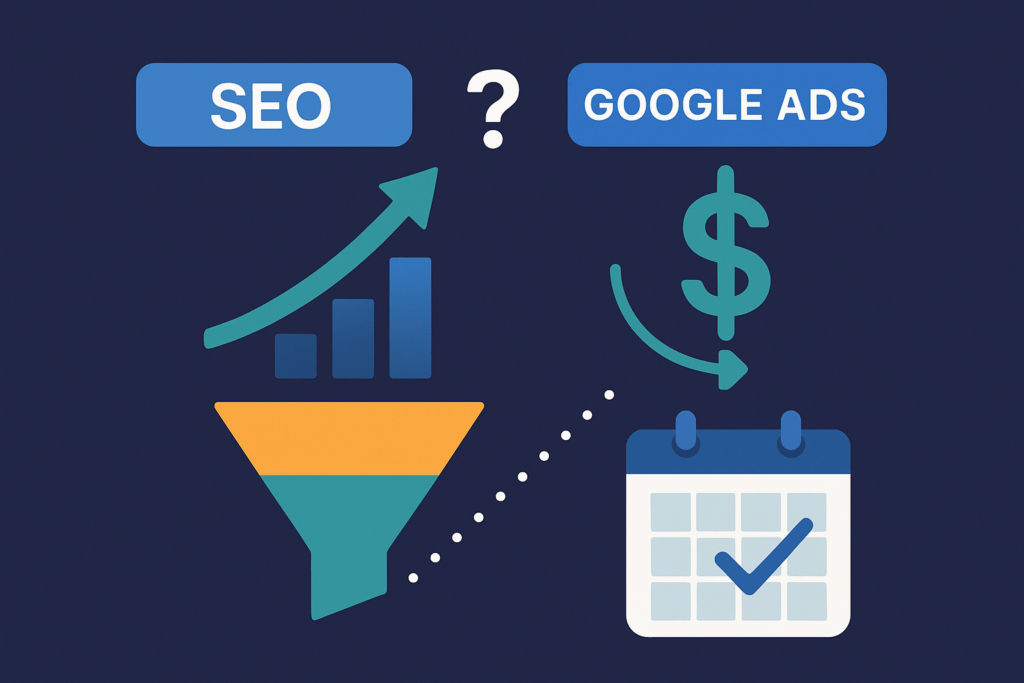
The Australian Search Landscape in Plain Numbers
Google dominates search in Australia with an overwhelming market share, which means your strategy here is largely Google strategy. Mobile drives the majority of searches—particularly in consumer segments—so if your site isn’t mobile-optimised, you’re already behind.
Local intent is strong. If you operate in trades, healthcare, hospitality, or retail, a significant portion of searches include location signals or map interactions. People searching for “plumber near me” or “café Fitzroy” want local results, and Google knows it.
Click prices vary by city and intent. Brisbane and Adelaide often see lower CPCs than Sydney and Melbourne for the same term. High-intent phrases in legal, finance, and B2B SaaS can run well into double digits per click. Local service terms typically sit in the mid-range depending on suburb competition and ad rank.
Organic results are increasingly blended with images, map packs, and product listings. That makes technical SEO and structured data worthwhile—visibility is no longer a simple list of ten blue links.
Time to impact is the big differentiator. Google Ads switches on revenue fast if your unit economics are sound. SEO takes time to earn links and trust—often months—although small wins with on-page fixes and internal linking can land inside a few weeks.
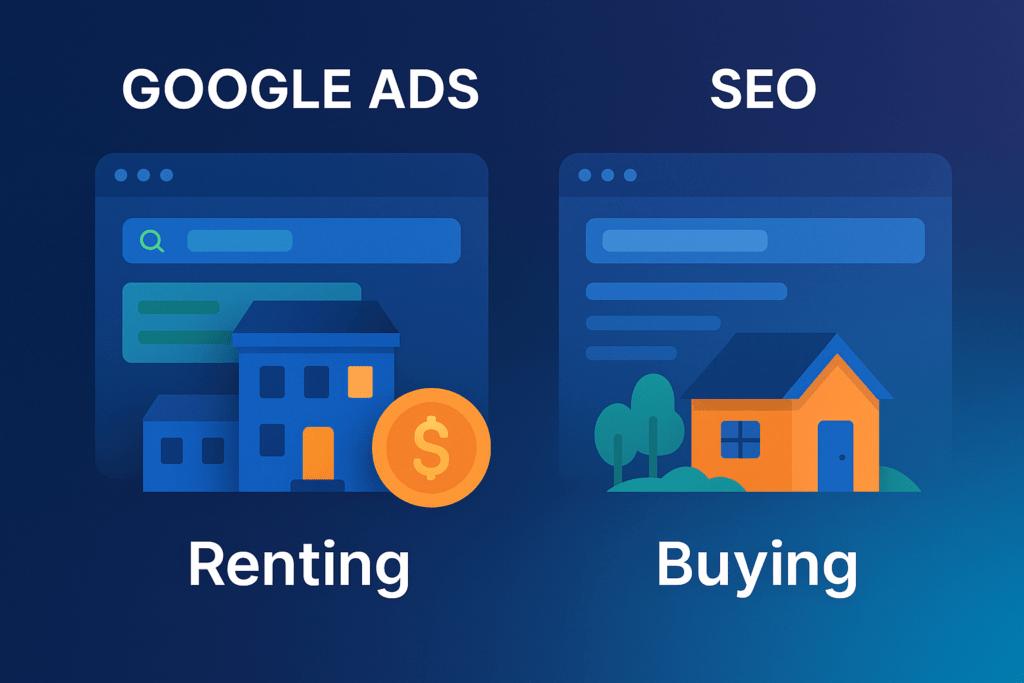
The Mental Shift: Renting Traffic vs. Owning Real Estate
In Australia, we understand the property market better than almost anyone. The most effective way to look at your digital marketing budget is through that same lens: are you renting your visibility, or are you buying it?
Google Ads is “Renting” :Think of PPC as a fully furnished apartment in a prime location. You pay the landlord (Google) a premium, and in exchange, you get to move in immediately. You’re on Page 1 instantly. It’s fast, convenient, and predictable. But there is a catch: you build no equity. The moment you stop paying the rent—whether your credit card expires or you pause the budget—you are evicted. Your traffic drops to zero overnight. You are trading money for immediate access.
SEO is “Buying” :SEO is like paying off a mortgage on a piece of land. It requires a significant upfront deposit (technical audits) and ongoing renovations (content creation and link building). In the first few months, it feels like a lot of work with no view. However, every optimisation you make is building digital equity. Over time, this asset belongs to you. Once you rank for high-value terms, that traffic keeps flowing 24/7 without you paying for every single click. You have moved from paying rent to owning the asset.
Why You Need Both: Most businesses can’t afford to wait 12 months for a house to be built before they have somewhere to live. You rent while you build. You use Google Ads (Rent) to get immediate customers and cash flow today, while simultaneously investing in SEO (Buying) to lower your living costs in the future. If you only rent, your costs will eventually become unsustainable as CPCs rise. If you only try to buy, you might starve before the house is finished. The winning strategy is to transition from a renter to an owner, without losing your place in the market.
What You Actually Get When You Buy SEO
SEO behaves like a compounding asset. You invest in technical health, on-page structure, content that matches search intent, and authority from mentions and links. Once rankings stick, the cost per click trends down while volume keeps arriving.
Benefits go beyond traffic. Strong rankings for high-intent queries build brand recall and trust. When people see you ranking organically at the top, they trust you more. Your analytics will show branded search rising after you secure non-branded rankings, which then lowers paid search costs as Quality Score improves.
There are limits. Results aren’t instant, and volatility happens after core algorithm updates. Brands that spread risk across topic clusters, keep site performance sharp, and maintain consistent publishing ride out swings better. Treat SEO like an owned media program with clear goals, not just a checklist.
What You Actually Get When You Buy Google Ads
Paid search buys speed and control. You choose the keywords, bids, locations, devices, ad copy, and landing pages, then see performance almost immediately. That makes it perfect for testing messages, pricing, and new offers before committing to longer SEO programs.
Modern account structures lean into broad match with strong negatives and smart bidding, Performance Max for shopping and discovery surfaces, and well-curated first-party audiences. When conversion tracking is clean and value-based bidding is enabled, the system will chase profitable queries you might not have planned for.
Trade-offs matter. CPC inflation is real in competitive industries for head terms. Ad policies, disapprovals, and brand safety rules can interrupt campaigns. Click spam is manageable with tools and IP exclusions but never zero. The solutions are clear targets, disciplined query mining, and frequent creative and landing page refreshes.
A Practical Comparison
Here’s how SEO and Google Ads stack up across the dimensions that matter most:
| Dimension | SEO | Google Ads |
| Speed to traffic | Slow at first, then compounds | Immediate, stops when spend stops |
| Cash flow | Upfront resource cost, low ongoing CPC | Ongoing cost per click with tight control |
| Predictability | Less predictable month to month | Highly tunable with budgets and bids |
| Moat creation | Durable rankings and links | Auction-based, competitors can outbid |
| Measurement | Attribution to content can be fuzzy | Conversion tracking is granular |
| Team skills | Technical, editorial, digital PR | Bidding, creative testing, analytics |
| Volatility | Algorithm updates and SERP changes | Auction pressure and policy shifts |
| Long-term CAC | Tends to fall as authority grows | Stable if Quality Score and CVR stay strong |
Budget Splits That Tend to Work
No one-size rule fits every business, though patterns do repeat by stage and objective. The splits below are a starting point, not a ceiling.
For businesses seeking quick revenue validation or pushing a new product, heavier paid spend makes sense in the first 90 to 120 days. As you accumulate data and find queries that convert, move those topics into SEO content briefs and technical site improvements. Established brands with stable funnels typically move toward a majority SEO allocation over 12 months because the compounding effect becomes obvious.
After considering your time horizon and cash position, aim for a test budget that can produce statistically useful data, not just clicks. That often means at least 100 to 200 targeted conversions across your key campaigns.
Here’s a quick guide you can test with your own numbers:
If you’re launching a new offer or entering a new market (0-6 months), allocate 70-90% to Google Ads and 10-30% to foundational SEO. Speed matters here, and you need data fast.
For an established local service with strong reviews, split it roughly evenly: 40-60% to Google Ads and 40-60% to SEO. You’ve got the trust signals, now build on them.
E-commerce sites with over 1,000 SKUs should lean heavier into SEO: 30-50% to Google Ads and Shopping, 50-70% to SEO and product content. Your catalogue is your moat.
B2B SaaS companies with long sales cycles benefit from content-led growth: 30-40% to Google Ads, 60-70% to SEO and content-led demand capture. Build authority while you nurture leads.
Seasonal businesses should front-load paid spend during peak months, then invest in SEO during the off-season to rank before the next cycle hits.
The Maths Behind Sensible Bids and Content Investment
Decisions get easier when you run the numbers. Calculate a breakeven CPC so you know what you can afford in Google Ads, and calculate a target cost per session for SEO so you know what production should cost over a realistic timeframe.
Breakeven CPC for Paid Search
Take conversion rate from click to sale or lead, multiply by profit per sale, then multiply by the share of profit you’re happy to spend on acquisition.
Example: If conversion rate is 3% and net profit per sale is $120, then revenue per click is $3.60. If you’re comfortable spending 60% of profit to win the sale, your max CPC is $2.16. If the auction sits at $4 for the same query, you either need higher conversion rates, a better average order value, or a different keyword set.
SEO Cost Per Session
Estimate the monthly organic clicks a planned topic can achieve at page one, factor in content and outreach costs, then spread the investment over 12 to 24 months.
Example: If a topic cluster costs $6,000 to produce and earns 1,000 organic visits per month at maturity, the 12-month cost per session is roughly $0.50, dropping to $0.25 over 24 months. Now compare that to paid CPC for the same terms to prioritise.
Set realistic time to impact. Technical fixes like improving Core Web Vitals or cleaning up duplicate content can move the needle within weeks. Authority building and net new rankings for competitive topics can take several months in Australia—shorter for niche local terms, longer for national finance queries.
Local Nuances for Australia That Move the Needle
There are a few Australia-specific things to keep in mind. Google Ads invoices include GST for Australian accounts. Most GST-registered businesses can claim this back, but it impacts cash timing for smaller firms.
Privacy rules are getting stricter. You’ll need to set up consent mode and consider server-side tagging to keep your conversion data accurate. ACCC guidance on testimonials and pricing transparency also applies to ad creative, so train your team to avoid overclaims in both ads and meta descriptions.
Geo strategy matters. Regional Australia is often under-targeted. If your service area genuinely includes Newcastle, Wollongong, Sunshine Coast, Geelong, or Hobart, run dedicated campaigns with distinct ad copy and landing pages. CPCs are often lower and conversion intent can be higher than CBD terms.
On the SEO side, Google Business Profile quality is non-negotiable for local businesses. Photos, services, categories, and consistent NAP data across major directories influence map pack inclusion. Reviews are both a ranking and conversion lever. If you’re a tradie in Western Sydney or a café in Fitzroy, getting your Google Business Profile dialled in matters more than chasing national rankings.
Build a simple process to request reviews after service delivery and respond quickly to all feedback.
A few priorities that produce outsized returns:
Structured data and feeds are non-negotiable. Product schema, organisation schema, local business schema, and a clean Merchant Center feed improve both SEO visibility and Shopping performance.
Fast landing pages directly impact profitability. Sub-two-second LCP on mobile increases Quality Score, improves conversion rate, and supports organic rankings.
Message testing creates a feedback loop. Rotate offers, price framing, and social proof in ads, then promote winners into title tags and H1s for SEO.
How SEO and Google Ads Should Feed Each Other
One of the biggest mistakes businesses make is treating SEO and Google Ads as separate channels with separate goals. In reality, they work best when they share data and inform each other’s decisions.
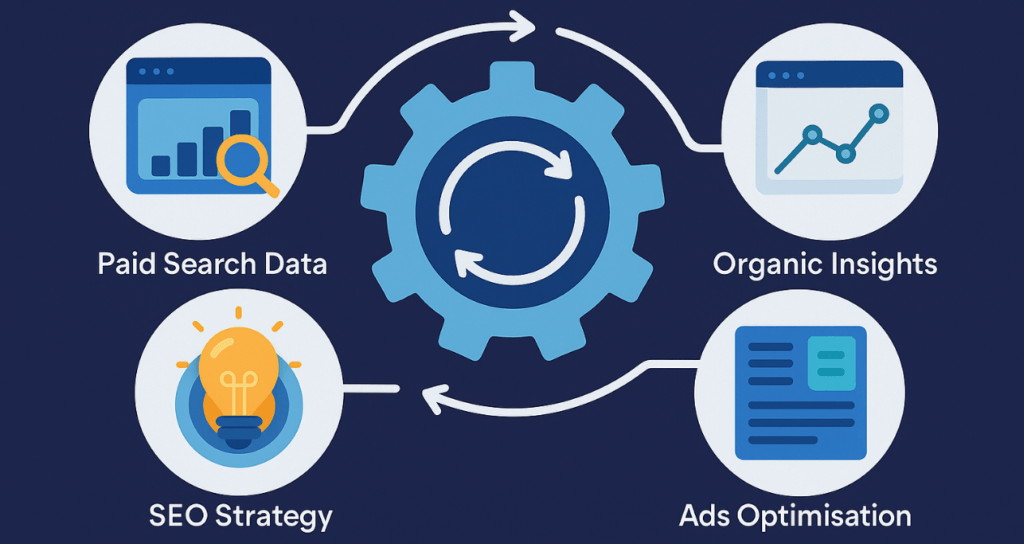
Google Ads is your fastest source of truth. Paid search reveals, in real time, which queries convert, which messages resonate, and where price sensitivity or friction appears. Instead of guessing which keywords deserve long-term SEO investment, paid search validates intent using real users and real spend. Keywords that consistently generate profitable conversions in Ads are strong candidates for deeper SEO investment—through dedicated landing pages, content clusters, internal linking, and supporting FAQs. This approach significantly reduces SEO risk by prioritising proven commercial intent over raw search volume.
SEO data then feeds back into paid search optimisation. Google Search Console surfaces queries with high impressions but weak click-through rates, signalling unmet expectations or unclear messaging. Testing alternative headlines, offers, and positioning in Google Ads allows teams to quickly identify what improves engagement, then apply those learnings back to organic meta titles, descriptions, and on-page copy. As organic listings become more compelling and brand familiarity increases, paid search often benefits from improved Quality Scores and lower CPCs—particularly for branded and mid-funnel queries.
The most effective teams also use time as a strategic lever. Google Ads excels at short-term validation and rapid experimentation, while SEO compounds results over the long term. High-performing paid keywords should eventually graduate into SEO assets. As organic rankings stabilise, paid spend can be reduced or redirected toward new markets, new offers, or fresh testing. This creates a sustainable feedback loop where paid search acts as the testing engine and SEO becomes the long-term efficiency layer.
When SEO and Google Ads share data, budget discussions stop being ideological. They become operational decisions driven by evidence, timing, and return—allowing businesses to grow without overpaying for traffic or waiting blindly for results.
Bringing the Channels Together Without Waste
The mistake most teams make is working channels in isolation. Paid search query reports are a goldmine for SEO topics, and Search Console impressions are a roadmap for low-hanging paid search terms. Tie the two together in weekly reviews, then update bid modifiers and content calendars accordingly.
If your brand name is being poached by competitors, keep a small always-on brand campaign to protect your SERP at a low CPC. If branded CPCs creep up, it’s a signal to invest more in organic sitelinks, FAQ schema, and reputation building to push competitors down the page.
Don’t ignore creative. Fresh ad copy improves click-through rate which lowers CPC via better expected CTR. On the organic side, rewrite meta titles and descriptions to borrow winning angles from ads. You’ll get more clicks without a single rank change.
What Actually Determines Your Optimal Split
There’s no universal answer because the right allocation depends on factors specific to your situation: Market maturity matters. Entering a new category or location? You need speed, which means heavier paid spend. Established in your niche? Compounding SEO probably makes more sense. Competitive intensity shapes the equation. In crowded markets with high CPCs, organic rankings become more valuable. In blue ocean spaces, paid can dominate profitably for years. Your offer’s proven status changes everything. Validated products with strong unit economics can scale paid aggressively. Unproven offers need testing budgets, not massive SEO programs. Team capability isn’t neutral. If you can’t execute technical SEO properly, paying for it wastes money. If your ads aren’t converting, throwing more budget at them compounds the problem. The businesses that get this right don’t follow formulas—they measure what works in their specific context and adjust accordingly.
The Final Verdict: Control Your Speed, Own Your Growth
When you frame SEO as a compounding asset and Google Ads as a precision throttle, the path forward becomes clear. You are no longer trapped in a debate about “which channel is better.”
Instead, you are making a strategic investment decision: How much revenue speed do you need this quarter, and how much market dominance do you want to build for next year?
Don’t leave your digital presence to chance. Use the precision of Ads to win today, and the compounding power of SEO to secure tomorrow. That is how market leaders are built.